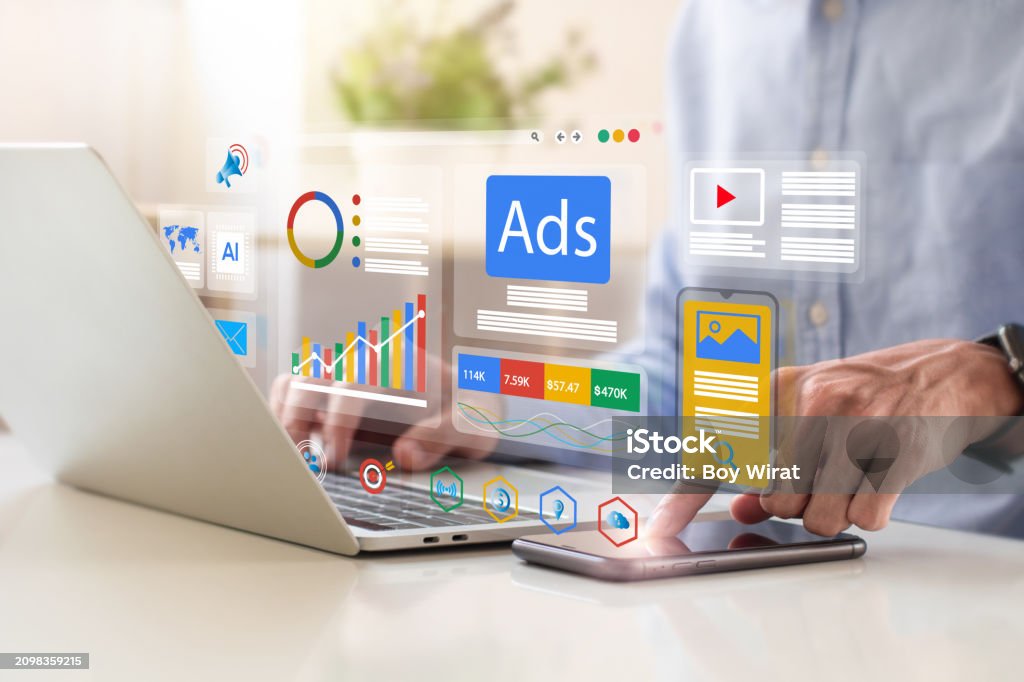
Digital marketing concept, Businessman using laptop with Ads dashboard digital marketing strategy analysis for branding. online advertisement, ad on website and social media. SEO. SMM.
When I first heard about Artificial Intelligence in marketing, I’ll admit I brushed it off as just another buzzword — something tech companies would obsess over while small business owners like me continued doing things the traditional way. For years, I believed good marketing was all about intuition, creativity, and human emotion. Machines, I thought, could never truly understand that.
But then, somewhere between struggling to create personalized content, missing analytics deadlines, and juggling multiple marketing campaigns, I realized — maybe AI wasn’t here to replace the human touch. Maybe it was here to make it stronger.
This is my story of how I went from being skeptical about AI to embracing it as a silent partner that changed how I viewed marketing — and connection itself.
When Data Became Overwhelming
It started innocently enough. My business was growing, but so were the challenges. I was collecting data from everywhere — website visitors, social media insights, customer feedback forms, email open rates — but I wasn’t doing anything meaningful with it.
It felt like trying to drink water from a firehose. Too much information, too little clarity.
That’s when I stumbled upon an AI-powered analytics tool. At first, I thought it was just fancy reporting software, but as I started using it, I realized it could do something far more valuable — it understood patterns that I couldn’t see.
It showed me when my audience was most active, what kind of content they engaged with, and even predicted which products were likely to trend in the coming months. It wasn’t about replacing my creativity; it was about guiding it.
And just like that, my marketing became smarter — not harder.
The Human Side of AI
There’s a misconception that AI strips away emotion, but what I discovered was quite the opposite. With AI handling the repetitive and data-heavy tasks, I suddenly had time to focus on storytelling — the emotional heart of marketing.
For instance, my email campaigns had always been hit or miss. But after integrating AI-driven personalization, something incredible happened. Emails stopped feeling like generic blasts and started feeling like personal letters. Customers responded as if they were being spoken to directly.
The open rates skyrocketed, but more importantly, so did the responses that began with, “This email felt like it was written just for me.”
That’s when I realized — AI didn’t remove the human touch; it enhanced it. It gave me the insight to communicate better, to listen closer, and to connect deeper.
Predicting What’s Next
AI’s predictive capabilities fascinated me the most. It wasn’t just analyzing the past; it was forecasting the future.
It helped me identify trends before they exploded — the kind of insight that used to take hours of research or guesswork. For example, before a major festival, my AI dashboard highlighted a spike in interest for certain types of products and color themes. Acting on it early, I created campaigns around those preferences — and the results were beyond what I had expected.
That’s the beauty of AI in marketing — it gives you a head start, a glimpse into what’s coming, so you can act with confidence rather than luck.
The Rise of Smart Content
One of the biggest shifts I noticed was in how I approached content creation. Before, I would write what I thought people wanted. Now, AI helps me understand what they’re actually looking for.
AI tools suggest keywords, topics, and even emotional tones that resonate with my audience. Sometimes, it even generates outlines or captions that I can fine-tune.
But I don’t let AI write everything for me — that’s where I draw the line. Because while machines can analyze patterns, they can’t feel them. The best content, I believe, is when human emotion meets machine precision.
So I let AI do the heavy lifting — researching, optimizing, and scheduling — while I focus on injecting my personality, humor, and empathy into every message.
That collaboration feels like the perfect balance between heart and logic.
Chatbots That Actually Feel Human
If there’s one area where I saw the most dramatic transformation, it’s customer communication.
Before AI, replying to every query felt like a never-ending task. I dreaded missing messages or responding late. But now, with an AI chatbot managing first-level responses, customers get instant replies — day or night.
At first, I was nervous about letting a machine handle conversations. But to my surprise, customers loved it. The chatbot was polite, patient, and surprisingly intuitive. It didn’t sound robotic at all.
Of course, for complex queries, it passed the chat to me — but by then, the customer already felt heard.
It wasn’t about replacing me; it was about making me more available. And in a world where attention is the new currency, that made all the difference.
The Ethical Pause
Despite the many advantages, there were moments I stopped to think — how much is too much?
AI can predict behavior, but should it? It can personalize ads to an almost uncomfortable degree. At what point does personalization become intrusion?
These questions reminded me that while AI is powerful, it needs direction — human direction. Ethics, empathy, and transparency can’t be programmed; they must be practiced.
That realization shaped how I used AI — not to manipulate, but to understand. Not to push, but to guide.
From Fear to Freedom
I’ll be honest — my early fear of AI came from a place of misunderstanding. I thought it would make creativity obsolete. Instead, it freed it.
AI gave me the tools to focus on what truly matters — crafting meaningful campaigns, building real relationships, and telling better stories.
With automation handling the repetitive tasks, I found more mental space to think strategically. My stress levels dropped, my productivity rose, and my creativity finally had room to breathe.
It was like having a brilliant assistant who never slept — one that organized, analyzed, and suggested, but never took the spotlight away from me.
The Future That’s Already Here
Looking ahead, I can only imagine how much more AI will evolve. We’re already seeing advancements in voice search optimization, predictive content, visual recognition, and hyper-personalized ads. Soon, AI might not just help us market — it might help us create entirely new forms of experiences.
Imagine an AI that understands human emotion so well it can help brands design stories that move people to tears. Or tools that predict not just buying behavior, but social impact.
But amidst all these possibilities, one truth remains: marketing will always be about humans — their needs, dreams, and emotions. AI is simply the bridge that helps us reach them more efficiently and meaningfully.
The Subtle Shift
When I look back, it’s incredible to see how far I’ve come — from struggling with spreadsheets to managing AI-powered campaigns that practically run themselves.
But beyond the technology, the real transformation was internal. I stopped fearing the future. Instead, I started shaping it — one data-driven, emotionally grounded campaign at a time.
That’s what the future of AI in marketing truly means to me: not a cold takeover, but a warm collaboration. Not robots replacing humans, but helping us understand each other better than ever before.
Because at the end of the day, whether it’s an algorithm or a human heart behind the screen, what truly connects people — is still emotion.
Final Thoughts
AI may be the future of marketing, but the soul of it will always remain human. The best marketers will be those who know how to combine both — the logic of data and the art of empathy.
For me, AI became more than a tool; it became a partner in storytelling. Together, we’ve created campaigns that not only performed better but felt better — because they understood people.
So, if you’re standing on the edge of this AI revolution wondering whether it’s for you — take that leap. Start small, stay human, and let technology amplify your voice, not replace it.
Because the future of marketing isn’t about machines taking over — it’s about humans finally being able to do what they do best: connect, create, and inspire.


Content is king, but distribution is queen! Excellent points on promotion strategies.
Content is king, but distribution is queen! Excellent points on promotion strategies.
Data-driven decisions are the only way to scale. Thanks for highlighting the importance of analytics.
Content is king, but distribution is queen! Excellent points on promotion strategies.