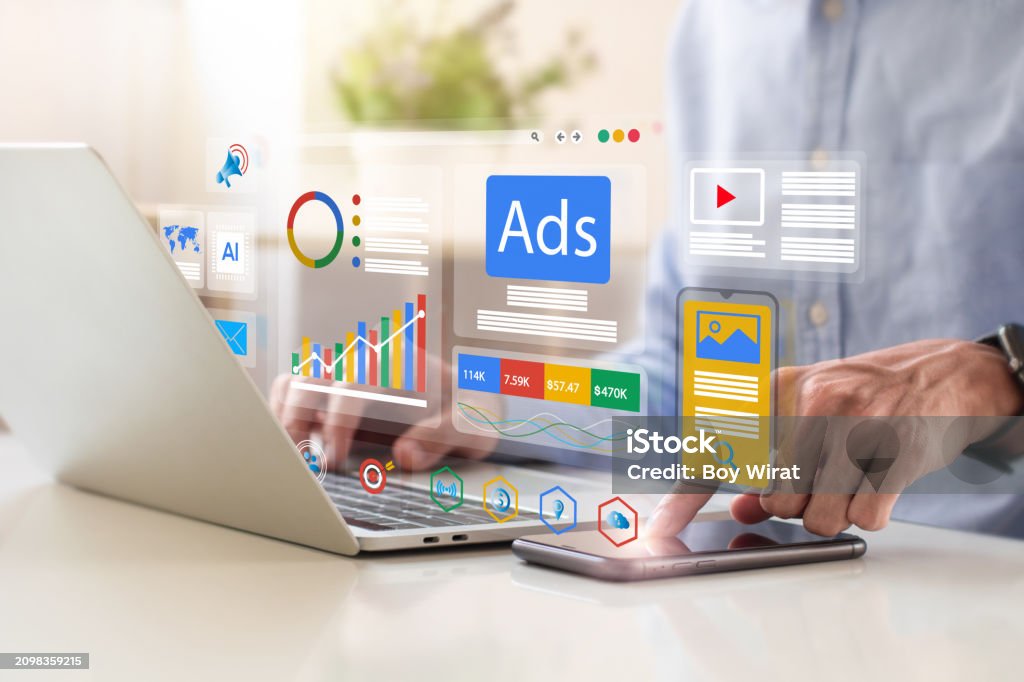
Digital marketing concept, Businessman using laptop with Ads dashboard digital marketing strategy analysis for branding. online advertisement, ad on website and social media. SEO. SMM.
Introduction
Google Ads has been the backbone of digital advertising for over two decades. With billions of searches happening daily, it allows businesses to reach their audience at the exact moment they are searching for a product or service.
In 2025, Google Ads has become even more AI-driven, data-centric, and competitive. Marketers who understand its evolving features can generate higher ROI, while those who rely on old strategies risk wasting ad spend.
This comprehensive guide explains how Google Ads works today, the latest updates, campaign types, best practices, and future trends every marketer should know.
1. What is Google Ads?
Google Ads is Google’s online advertising platform where businesses pay to show ads across Google Search, YouTube, Gmail, Maps, and millions of partner websites.
It operates on a Pay-Per-Click (PPC) model, meaning advertisers pay when users click their ads.
Benefits of Google Ads:
- Reach billions of users daily.
- Highly targeted (keywords, demographics, location, interests).
- Measurable ROI with detailed analytics.
- Flexible budget control.
- Works for both small businesses and global brands.
2. Types of Google Ads Campaigns in 2025
- Search Ads
- Appear on Google Search results when users type keywords.
- Best for intent-driven conversions (e.g., “buy running shoes online”).
- Appear on Google Search results when users type keywords.
- Display Ads
- Visual ads across Google Display Network (2M+ websites & apps).
- Great for brand awareness and retargeting.
- Visual ads across Google Display Network (2M+ websites & apps).
- Shopping Ads
- Show product images, price, and store info on Google Shopping.
- Ideal for e-commerce businesses.
- Show product images, price, and store info on Google Shopping.
- Video Ads
- Run on YouTube and Google video partners.
- Perfect for storytelling, brand recall, and product demos.
- Run on YouTube and Google video partners.
- App Ads
- Promote apps across Google Play, YouTube, Search, and Display.
- Promote apps across Google Play, YouTube, Search, and Display.
- Performance Max Campaigns (PMax)
- AI-powered campaigns running across all Google platforms.
- Automated bidding, creative optimization, and targeting.
- AI-powered campaigns running across all Google platforms.
- Local Services Ads
- Appear above search results for service businesses (e.g., plumbers, electricians).
- Pay per lead instead of per click.
- Appear above search results for service businesses (e.g., plumbers, electricians).
3. How Google Ads Bidding Works
Google Ads uses auction-based bidding:
- Advertisers set a max bid (how much they’re willing to pay per click).
- Google considers bid amount + quality score.
- Ad Rank = Bid × Quality Score determines ad position.
Quality Score is based on:
- Ad relevance to keywords.
- Expected CTR (Click-Through Rate).
- Landing page experience.
👉 Higher Quality Score = lower CPC and better placement.
4. Keyword Strategy for Google Ads
- Keyword Match Types:
- Broad Match: Shows ads for related searches.
- Phrase Match: Ads show when search includes the phrase.
- Exact Match: Ads show for exact keyword.
- Broad Match: Shows ads for related searches.
- Negative Keywords:
- Exclude irrelevant traffic (e.g., “free,” “jobs,” “cheap”).
- Exclude irrelevant traffic (e.g., “free,” “jobs,” “cheap”).
- Long-Tail Keywords:
- Lower competition, higher intent (e.g., “best running shoes for flat feet”).
- Lower competition, higher intent (e.g., “best running shoes for flat feet”).
- Keyword Research Tools:
- Google Keyword Planner
- SEMrush
- Ahrefs
- Ubersuggest
- Google Keyword Planner
5. Google Ads Extensions (Must-Use in 2025)
Extensions improve CTR by making ads more clickable:
- Sitelink Extensions (extra links).
- Callout Extensions (short benefits like “Free Shipping”).
- Call Extensions (click-to-call numbers).
- Location Extensions (map + address).
- Price Extensions (show product prices).
- Image Extensions (add visuals to ads).
6. Smart Bidding & Automation
AI has transformed bidding:
- Target CPA (Cost per Acquisition) – Google optimizes for lowest cost per conversion.
- Target ROAS (Return on Ad Spend) – Focuses on maximizing revenue.
- Maximize Conversions – Uses machine learning to get the most conversions.
- Maximize Clicks – Useful for traffic campaigns.
Automation also helps with:
- Dynamic ad creation.
- Responsive search ads (multiple headlines + descriptions).
- Smart creative testing.
7. Measuring Success (KPIs)
Track these Google Ads metrics:
- CTR (Click-Through Rate): Measures ad engagement.
- CPC (Cost Per Click): Cost for each click.
- Conversion Rate: % of clicks leading to sales/actions.
- Quality Score: Google’s rating of your ad relevance.
- Impression Share: % of times ads show compared to competition.
- ROAS: Return on Ad Spend (revenue ÷ cost).
8. Google Ads Best Practices for 2025
- Use Performance Max campaigns for AI-driven optimization.
- Combine Search + Display + YouTube retargeting for full funnel coverage.
- Focus on mobile-first ads (70%+ traffic is mobile).
- Use video ads — YouTube is the 2nd largest search engine.
- Continuously A/B test ad copies and landing pages.
- Implement conversion tracking + GA4 integration.
- Use remarketing campaigns to bring back lost visitors.
9. Common Mistakes to Avoid
- Targeting too many broad keywords.
- Ignoring negative keywords.
- Not optimizing landing pages (slow, irrelevant).
- Over-relying on automation without monitoring.
- Poor ad copy (not highlighting benefits or CTA).
- Forgetting to track conversions.
10. Future of Google Ads
- AI-Powered Campaigns: Even deeper automation & predictive targeting.
- Voice Search Ads: Optimizing for conversational queries.
- AR/VR Ads: Interactive ads for shopping experiences.
- Privacy-First Targeting: With cookie restrictions, first-party data will dominate.
- Integration with AI Chatbots: Ads tied into conversational commerce.
Conclusion
Google Ads in 2025 is smarter, more automated, and highly competitive. Businesses that learn how to balance AI-driven automation with human creativity will see the highest returns.
Whether you’re a small local store or a global brand, Google Ads gives you the ability to connect with customers at the exact moment of intent. By choosing the right campaign type, targeting the right keywords, optimizing bids, and tracking results, you can turn every ad dollar into measurable growth.
If you want to succeed in digital marketing, mastering Google Ads is no longer optional — it’s essential.


Data-driven decisions are the only way to scale. Thanks for highlighting the importance of analytics.
Content is king, but distribution is queen! Excellent points on promotion strategies.